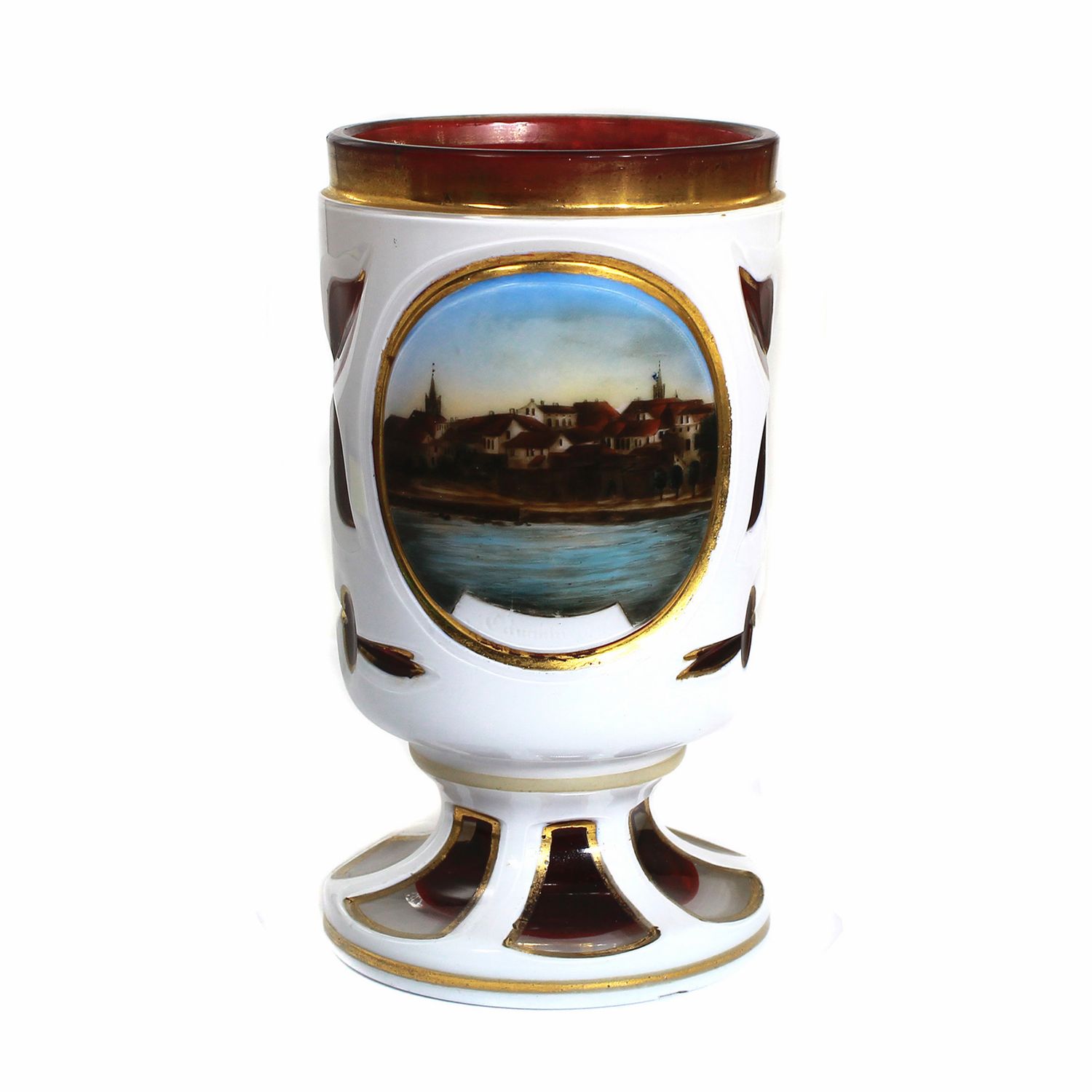
Footed beaker with overlay and a view of Cammin, Josephinenhütte, c. 1845–50
SKU i465
315€
Excl. shipping
Estimated delivery time
Pickup: tomorrow, 11:00–18:00
In stock: 1 available
1
Save this product for later
Footed beaker with overlay and a view of Cammin, Josephinenhütte, c. 1845–50
Product Details
Glashütte: Josephinenhütte
Footed beaker made of heavy, colorless glass with an overlay of white tin-enamel and an underlay of gold-ruby glass. It features a rising, circular base with arched facets. The body, decorated with ornamental wheel-cut patterns and gold outlines, displays a polychrome enamel painting depicting a view of Cammin in Pomerania (a spa town in Silesia). On the reverse side is a rosette composed of small, raised glass beads (prunts). The beaker has a distinct rim and a pontil mark (base bead) on the underside. There is a small bubble near the top of the base and a minor chip on the lower edge of the foot; the gold rim shows signs of wear. Produced by the Count Schaffgotsch-owned Josephinenhütte, circa 1845–50; designed by Franz Pohl. Height: approx. 13.7 cm; diameter: approx. 7.3 cm. Ref.: A comparable piece is held in the Passau Glass Museum (Room 3, Display Case 52). See also: Stefania Zelasko, *Josephinenhütte 1842–1900*.
Display prices in:EUR
